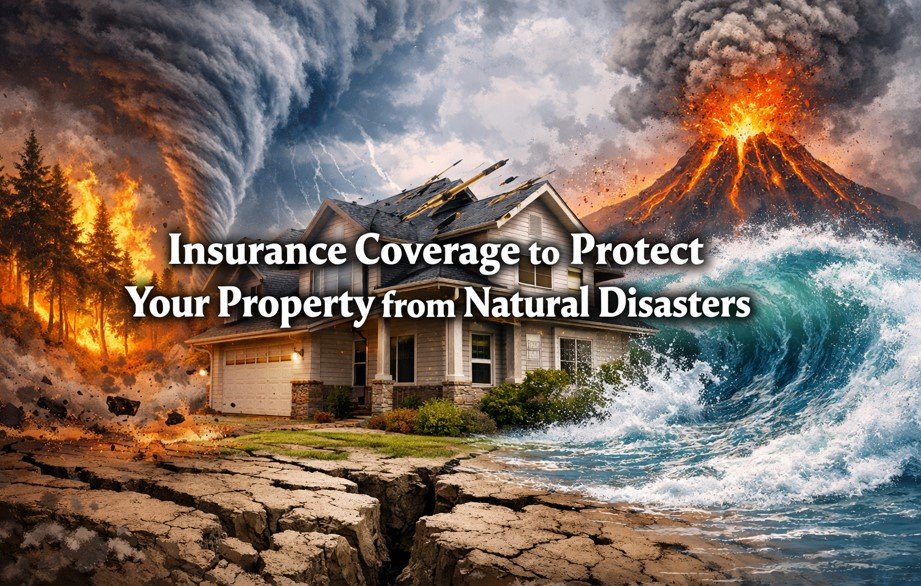
Insurance coverage to protect your property from natural disasters is the single most important safety net for homeowners and business owners facing the increasing volatility of global weather patterns.
Whether you are dealing with the sudden fury of a tornado or the creeping threat of rising floodwaters, having the right policy ensures that a physical catastrophe doesn’t become a permanent financial ruin.
Insurance coverage to protect your property from natural disasters often requires a more nuanced approach than a standard “one-size-fits-all” homeowners policy, as many people mistakenly believe their basic plan covers every act of nature.
In reality, the difference between total recovery and total loss often lies in the “fine print” and the specific endorsements you choose to add before the clouds begin to gather.
Understanding the Basics of Disaster Insurance
To truly master the nuances of insurance coverage to protect your property from natural disasters, one must look beyond the premium costs and dive into the structural anatomy of a policy.
Standard insurance is rarely a monolith; instead, it is a collection of specific “baskets” of protection, each designed to catch a different type of financial falling knife.
Understanding these components in detail is the difference between a smooth reconstruction process and a bureaucratic nightmare when the clouds finally clear.
Insurance coverage to protect your property from natural disasters relies heavily on how your “dwelling” is defined and valued by your provider.
This isn’t just about the bricks and mortar you see; it’s about the invisible costs of labor, local building codes, and the surging price of raw materials that inevitably skyrocket following a regional catastrophe.
Dwelling Coverage and Structural Integrity
Dwelling coverage is the cornerstone of any property policy. It specifically protects the physical structure of your home, including the roof, walls, floors, and windows, as well as attached structures like a garage or a deck.
In the context of natural disasters, this is where the “Replacement Cost” versus “Actual Cash Value” debate becomes critical.
If a hurricane strips the roof off your home, Actual Cash Value would only pay you what a 15-year-old roof is worth today, which isn’t much. Replacement Cost coverage, however, pays to put a brand-new roof over your head regardless of depreciation.
Furthermore, you should look for “Extended Replacement Cost” or “Ordinance or Law” coverage. These riders are essential because, after a major disaster, local building codes may have changed, requiring more expensive materials or safer wiring than what was originally in your home.
Without these specific additions to your insurance coverage to protect your property from natural disasters, you might be left paying tens of thousands of dollars out of pocket just to bring your rebuilt home up to modern legal standards.
Personal Property and Contents
While the dwelling coverage fixes the “shell,” Personal Property coverage is what replaces your life inside that shell. This includes everything from your refrigerator and couch to your socks and silverware.
Most people significantly underestimate the value of their belongings. In the event of a wildfire or a total-loss tornado, you are essentially asking your insurance company to buy you a lifetime’s worth of possessions all at once.
It is vital to ensure your policy is set to “Replacement Cost” for contents as well. If you have high-value items, such as jewelry, fine art, or professional-grade musical instruments, be aware that standard policies have “sub-limits” (often as low as $1,500) for these categories.
To truly have adequate insurance coverage to protect your property from natural disasters, you may need to “schedule” these items individually, which ensures they are covered for their full appraised value rather than a generic flat fee.
Safeguarding the Entire Perimeter
A property is often more than just a house; it includes fences, detached garages, sheds, gazebos, and even expensive landscaping or retaining walls. These are classified under “Other Structures” coverage, which is typically calculated as a percentage (often 10%) of your total dwelling coverage.
If you have a high-end detached workshop or an elaborate outdoor kitchen, that standard 10% might be woefully inadequate.
When auditing your insurance coverage to protect your property from natural disasters, you must account for the “flying missile” effect of high winds.
A storm might leave your house standing but completely obliterate a $20,000 fence or a detached guest suite. Ensuring this limit is adjusted to reflect the actual rebuilding costs of your outbuildings is a step many homeowners skip, only to regret it when the claims adjuster arrives.
Loss of Use
Perhaps the most overlooked element of insurance coverage to protect your property from natural disasters is “Loss of Use” or “Additional Living Expenses” (ALE). If a flood or earthquake renders your home uninhabitable, you don’t just lose your property; you lose your stability.
ALE covers the cost of hotel stays, temporary apartment rentals, and even the “increased cost” of food because you are forced to eat out rather than cook at home.
This coverage is a literal lifesaver during the months (or even years) it can take to rebuild after a major disaster. It ensures that while you are paying your mortgage on a house you can’t live in, you aren’t also drowning in hotel bills.
You should check if your policy has a time limit (e.g., 12 or 24 months) or a monetary cap, as long-term displacement is a common reality in disaster-stricken zones where labor and materials are in short supply.
Liability Protection
While most focus on the physical damage to the building, natural disasters can create hazardous environments that lead to legal trouble.
If a storm knocks a tree from your yard onto a neighbor’s expensive car, or if a visitor is injured on your debris-strewn property following a disaster, Liability coverage steps in.
This portion of your insurance coverage to protect your property from natural disasters pays for legal defense costs and any settlements or judgments you might be found responsible for.
In an era of increasing litigation, having a robust liability limit (often recommended at $300,000 to $500,000 or supplemented by an Umbrella policy) protects your savings and future earnings from being seized due to an accident triggered by an “Act of God.”
The Big Exclusions: What Your Standard Policy Likely Misses
In the realm of financial planning, insurance coverage to protect your property from natural disasters is often misunderstood as a “catch-all” safety net.
Many homeowners operate under the dangerous assumption that a standard policy acts as a comprehensive shield against any event labeled an “act of God.”
However, the insurance industry categorizes risks with surgical precision, and what a layperson calls a “disaster” might be a “specifically excluded peril” in the eyes of an underwriter.
To truly secure insurance coverage to protect your property from natural disasters, you must identify the massive gaps that exist in a default contract and bridge them with targeted endorsements.
The Specifics of Flood Exclusions
Flood damage is arguably the most common and costly exclusion in the world of property insurance. A standard policy will typically cover water damage if it comes from “above”, such as rain entering through a hole in the roof created by a storm, but it will almost never cover water that enters from the ground up.
This includes storm surges, overflowing rivers, or even heavy surface water runoff from a torrential downpour. To gain insurance coverage to protect your property from natural disasters involving water, you must look to the National Flood Insurance Program (NFIP) or private flood insurers.
Without this specific addition, you are essentially self-insuring against one of the most frequent natural threats.
It is also important to note that flood insurance has its own set of internal exclusions; for instance, it rarely covers “finished” basements, meaning your expensive home theater or guest suite in the cellar might still be a total loss even with a flood policy in place.
Earthquakes and Earth Movement
Standard property insurance is designed for a world where the ground stays still. “Earth movement” is a broad exclusionary term used by insurers to deny claims related not just to earthquakes, but also to landslides, mudslides, and sinkholes.
If a tremor cracks your foundation or a mudflow triggered by heavy rain pushes your home off its footings, a standard policy will likely offer zero compensation. Achieving robust insurance coverage to protect your property from natural disasters of a geological nature requires a separate Earthquake policy or a “Difference in Conditions” (DIC) policy.
DIC policies are particularly valuable because they act as a “gap filler” for various earth-related perils that neither home nor flood insurance will touch.
Because these events are often catastrophic and affect entire communities at once, the deductibles for this coverage are usually calculated as a percentage of the home’s value (e.g., 10% or 15%), rather than a flat dollar amount.
Sewer Backup and Sump Pump Failure
While a hurricane or a massive storm is clearly a natural disaster, some of the most expensive damage they cause is secondary and often excluded.
When heavy rains overwhelm municipal systems, sewage can back up through your home’s drains, or your sump pump might fail due to a power outage, leading to a flooded basement.
Even though these events are triggered by a natural disaster, they are not covered under standard policies or even many flood policies.
To ensure your insurance coverage to protect your property from natural disasters is truly comprehensive, you must add a “Water Backup and Sump Overflow” rider.
This inexpensive endorsement provides a specific limit of insurance for the cleanup and repair of the hazardous mess left behind by a backup, which can easily cost tens of thousands of dollars in professional remediation and structural drying.
The Wind and Hail Gap
In regions prone to tornadoes, hurricanes, or severe hailstorms, insurers have moved toward a “split deductible” model that many policyholders don’t notice until it’s too late.
While your standard deductible might be $1,000 for a fire, your insurance coverage to protect your property from natural disasters involving wind or hail might carry a “Percentage Deductible.”
This means if your home is insured for $500,000 and you have a 5% windstorm deductible, you are responsible for the first $25,000 of damage. In high-risk areas, this essentially makes the insurance policy a “catastrophe-only” plan, leaving the homeowner to pay for “minor” disasters like a $15,000 roof replacement out of pocket.
Understanding this exclusion of “low-cost” claims is vital for your emergency savings strategy, as it represents a significant shift of risk from the insurer back to the property owner.
Maintenance and Neglect
Perhaps the most frustrating exclusion for many property owners is the “Maintenance Exclusion.” Insurance is designed to cover “sudden and accidental” events, not the gradual deterioration of a property.
If a natural disaster occurs, but the insurer can prove that the damage was worsened by pre-existing neglect, such as a 30-year-old roof that was already leaking or a foundation that was already cracked, they may deny the claim entirely or significantly reduce the payout.
To maintain the integrity of your insurance coverage to protect your property from natural disasters, you must treat home maintenance as a prerequisite for coverage.
An insurer might argue that a moderate windstorm only destroyed your roof because the shingles were already failing, turning a covered “act of nature” into an uncovered “maintenance issue.”
Comparing Coverage Types for Insurance Coverage to Protect Your Property from Natural Disasters
When navigating the complexities of insurance coverage to protect your property from natural disasters, the most critical step is moving beyond the “package” and into the “precision” of your policy types.
Not all coverage is created equal; in fact, two neighbors could have policies with the same monthly premium, yet one might receive a check for the full cost of a new home while the other is left with a massive financial gap.
By comparing the specific mechanisms of these coverage types, you can ensure that your financial safety net is made of steel, not gauze.
Insurance coverage to protect your property from natural disasters hinges on the fundamental architecture of your agreement; specifically, whether your insurer is looking at what your property was worth “then” or what it will cost to fix “now.”
In a world where construction costs and material prices fluctuate wildly following regional catastrophes, understanding these distinctions is the only way to guarantee your recovery.
The All-Encompassing Approach: Open Perils vs. Named Perils
One of the most vital comparisons to make is between “Open Perils” (also known as All-Risk) and “Named Perils” coverage.
An Open Perils policy is the gold standard for insurance coverage to protect your property from natural disasters because it automatically covers everything unless the policy specifically lists it as an exclusion.
This shifts the burden of proof to the insurance company; they must prove an event is excluded to deny a claim.
Conversely, a Named Perils policy only covers exactly what is written on the page, if a freak weather event occurs that isn’t explicitly named (like a specific type of ice damming or a rare volcanic ash event), you are on your own.
Most high-quality homeowners policies use Open Perils for the dwelling (the house itself) and Named Perils for your belongings, but for the ultimate protection, seeking a policy that offers Open Perils for both provides the most comprehensive security.
Replacement Cost Value vs. Actual Cash Value
The most significant financial variance in insurance coverage to protect your property from natural disasters lies in how the payout is calculated: Replacement Cost Value (RCV) versus Actual Cash Value (ACV).
RCV is designed to make you “whole” again by paying the actual current market price to buy new items or rebuild your home with modern materials, regardless of how old the original items were.
ACV, however, factors in depreciation. If a hurricane destroys a 10-year-old roof, an ACV policy will only pay you what a 10-year-old roof is worth today, which might only be 30% of the cost of a new one.
This “depreciation gap” can leave homeowners tens of thousands of dollars short during a crisis. For anyone serious about property protection, RCV is non-negotiable for both the structure and the personal contents.
Extended and Guaranteed Replacement Cost
Even a standard Replacement Cost policy can sometimes fall short if a massive regional disaster causes “demand surge”, a phenomenon where the price of lumber, shingles, and labor doubles overnight because everyone is trying to rebuild at once.
To truly fortify your insurance coverage to protect your property from natural disasters, you should look into “Extended Replacement Cost.” This endorsement provides an extra “buffer”, typically 25% to 50% above your policy limit, to account for these post-disaster price spikes.
For those seeking maximum peace of mind, “Guaranteed Replacement Cost” goes a step further, promising to rebuild your home to its original condition regardless of the cost, even if it exceeds the stated limit on the policy. This is the ultimate “inflation-proof” shield for your property.
Endorsements vs. Standalone Policies
When your standard policy excludes a major risk like flooding or earthquakes, you generally have two ways to fix it: adding an “endorsement” (a rider) or purchasing a “standalone policy.”
Endorsements are often more convenient and cheaper, as they simply “tack on” extra coverage to your existing homeowners account, common examples include sewer backup or jewelry riders. However, for high-magnitude risks like floods, a standalone policy is often the only option.
In 2026, the market for private flood and earthquake insurance has expanded significantly, offering higher limits and more flexible terms than the traditional government-backed programs.
Comparing these two methods is essential; sometimes a standalone policy offers much better “loss of use” benefits than a simple rider would, which could be the difference between staying in a comfortable rental or a crowded shelter after a disaster.
Parametric Insurance Solutions
A new and fascinating type of insurance coverage to protect your property from natural disasters is “Parametric Insurance.”
Unlike traditional insurance, which requires an adjuster to come out and inspect the damage, parametric insurance pays out automatically based on a specific “trigger”, such as a hurricane reaching a certain wind speed or an earthquake hitting a specific magnitude within a set distance of your home.
The payout is usually a fixed amount and arrives within days, providing immediate liquidity to cover emergency expenses or high deductibles.
While it isn’t a replacement for a full homeowners policy, it is increasingly being used as a “first-response” layer of protection that bridges the gap while you wait for the larger, more complex claims process of a traditional policy to conclude.
How to Maximize Your Protection and Lower Costs
In the high-stakes world of property ownership, insurance coverage to protect your property from natural disasters should be viewed as a dynamic financial strategy rather than a static monthly bill.
As we move through 2026, the insurance landscape is shifting from a reactive model, where you simply pay for damage after it occurs, to a proactive “resilience model” that rewards homeowners for fortifying their assets.
By aligning your property’s physical strength with your policy’s financial structure, you can create a virtuous cycle that maximizes your protection while simultaneously driving down the long-term cost of your premiums.
Insurance coverage to protect your property from natural disasters is increasingly influenced by “risk mitigation credits,” a system where insurers provide significant discounts to owners who prove their buildings can withstand the very elements they are insured against.
In an era where climate volatility is pushing standard rates higher, these strategic adjustments are no longer optional “extras”; they are the primary tools for maintaining an affordable and secure lifestyle.
Mitigation Upgrades and Premium Credits
The most direct way to lower the cost of insurance coverage to protect your property from natural disasters is to “harden” your home against specific regional threats.
In 2026, insurers are doubling down on science-based benchmarks like the FORTIFIED standard for wind and hail or Firewise USA for wildfire zones.
By installing impact-resistant “Class 4” roofing, sealing your roof deck to prevent water intrusion, or creating a 5-foot “non-combustible zone” around your foundation, you can often trigger automatic premium discounts of 10% to 25%.
These upgrades do more than just save money; they move your property into a “lower-risk tier” during the underwriting process, making your home more attractive to a wider range of competitive insurers.
The Deductible Strategy
Strategic deductible management is a powerful lever in controlling the price of insurance coverage to protect your property from natural disasters.
While it may be tempting to keep a low $500 deductible, many homeowners in 2026 are opting for $2,500 or even $5,000 deductibles to secure substantial premium relief, sometimes as much as 15% to 30% annually.
The key is to treat your insurance as a “catastrophe-only” tool rather than a maintenance fund. By self-insuring for smaller, manageable repairs and reserving your policy for total-loss events, you maintain a “clean claims history.”
In today’s market, even one or two small claims for minor wind damage can lead to a “non-renewal” notice or a massive rate hike, making the high-deductible approach both a cost-saver and a policy-preserver.
Smart Home Integration
We have entered an era where insurance coverage to protect your property from natural disasters is literally “connected” to the home.
Modern insurers are now offering significant credits for the installation of IoT (Internet of Things) devices, such as smart water shut-off valves and advanced fire-detection sensors that can alert both the homeowner and the fire department at the first sign of an ember.
Some innovative policies in 2026 even provide the hardware for free in exchange for a data-sharing agreement. These devices address the “secondary disasters”, like a pipe bursting after a freeze or a small fire starting during a storm, that account for a massive portion of annual claims.
By proving to your insurer that you have a “self-healing” home, you demonstrate a level of oversight that traditional homeowners simply can’t match.
Bundling and Loyalty
While technical upgrades are essential, the old-fashioned “bundle” remains one of the most effective ways to optimize insurance coverage to protect your property from natural disasters.
Combining your home, auto, and perhaps an umbrella liability policy with a single carrier can often shave 20% off your total bill.
Furthermore, in the volatile market of 2026, loyalty has renewed value. Many insurers now offer “tenure-based” benefits, such as vanishing deductibles or “claim forgiveness,” which prevent your rates from skyrocketing after a single weather-related event.
However, this must be balanced with a “triennial review”, every three years, you should have your agent shop your bundle against the market to ensure your “loyalty” isn’t actually costing you an “inertia tax.”
The “Build Back Better” Endorsement
Finally, maximizing your protection means looking at the day after a disaster strikes. Many forward-thinking policies now offer a “Build Back Better” or “Green Upgrade” endorsement.
For a very small additional fee, this feature provides extra funds during a claim to rebuild your home using more resilient or sustainable materials than what was originally there.
If a windstorm destroys your standard shingles, this endorsement would pay the difference to install a hail-resistant metal roof.
This turns a disaster into an opportunity to upgrade your property’s value and its future “insurability,” ensuring that your insurance coverage to protect your property from natural disasters is actually an investment in your home’s long-term survival.
Conclusion
Ultimately, insurance coverage to protect your property from natural disasters is about more than just paperwork; it’s about peace of mind. By identifying the specific risks to your region and filling the gaps in your standard policy, you can ensure that your home or business remains a source of security rather than a financial burden.