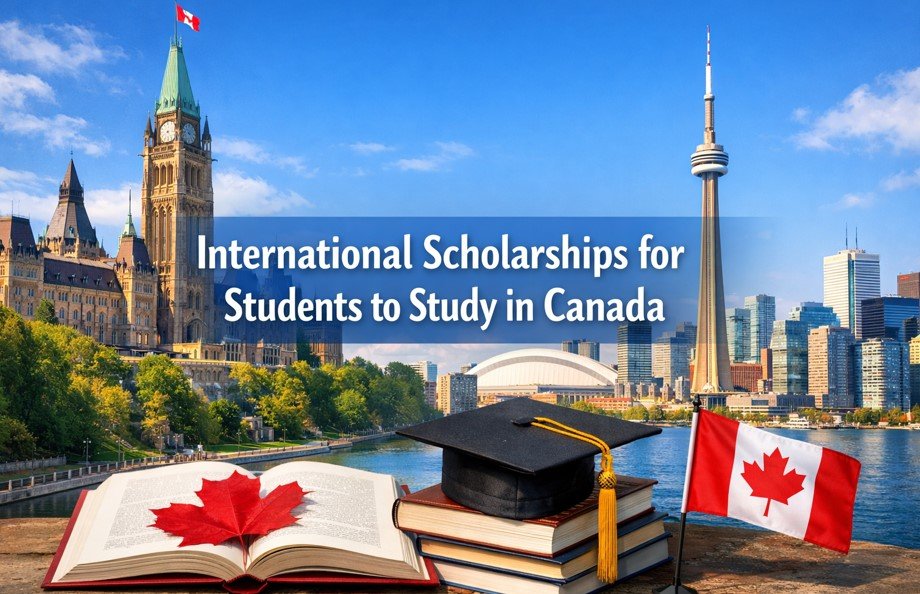
International scholarships for students to study in Canada have become the golden ticket for thousands of aspiring scholars worldwide who dream of a world-class education amidst breathtaking landscapes.
As the 2026/2027 academic season approaches, the Great White North continues to solidify its reputation as a premier global destination by offering a vast array of funding opportunities that cater to every level of study, from undergraduate degrees to advanced doctoral research.
International scholarships for students to study in Canada are not just about financial relief; they represent a bridge to a multicultural society, high-quality research facilities, and a post-graduation landscape filled with professional possibilities.
Whether you are aiming for a bustling city life or a quiet campus in a smaller town, the diversity of these awards ensures that financial barriers don’t stand in the way of your academic ambitions in North America.
Why Choose Canada for Your International Education?
Choosing where to spend your formative academic years is a monumental decision that shapes your future career and personal outlook.
While many countries offer high-quality degrees, Canada stands out as a holistic package that balances academic rigor with lifestyle and long-term security. Here is an in-depth look at why Canada remains the top-tier choice for international students in 2026.
World-Class Academic Excellence and Global Recognition
The primary driver for seeking international scholarships for students to study in Canada is the sheer quality of the Canadian education system.
Canadian universities are consistently ranked among the top in the world, with institutions like the University of Toronto, McGill University, and the University of British Columbia leading the pack.
In 2026, the University of Toronto made headlines by ranking in the top 30 globally across every single subject area tracked by major ranking bodies, a feat achieved by only a handful of schools worldwide.
Whether you are studying Quantum Computing at Waterloo or International Business at York’s Schulich School of Business, a Canadian degree carries a weight that is respected by employers and graduate schools across the globe.
The curriculum is designed with a heavy emphasis on research, innovation, and practical application, ensuring that graduates aren’t just “book smart” but are ready to solve real-world problems.
A Unique Focus on Experiential Learning and Co-op Programs
One of the most distinct advantages of studying in Canada is the integration of “Co-op” (cooperative education) programs. Unlike standard internships, Canadian co-op programs are structured, paid work terms that are built directly into your degree.
This means that a student can graduate with up to two years of professional, relevant work experience in their field. For many who secure international scholarships for students to study in Canada, these co-op terms provide an essential financial boost while simultaneously building a professional network.
Universities maintain strong partnerships with industry leaders in tech, healthcare, and engineering, allowing students to alternate between semesters of study and semesters of full-time work.
This “earn while you learn” model is a cornerstone of the Canadian value proposition, giving graduates a massive head start in the competitive global job market.
Unparalleled Post-Graduation Work Opportunities (PGWP)
Canada’s immigration policies are specifically designed to retain the talent that its universities produce. The Post-Graduation Work Permit (PGWP) is a significant draw for international scholars.
As of 2026, students who graduate from a degree program (Bachelor’s, Master’s, or PhD) at a designated learning institution are eligible for a work permit of up to three years, regardless of their field of study.
While 2026 has seen some tightening of rules for college diplomas to ensure they align with labor market needs (focusing on STEM, healthcare, and trades), the “university degree path” remains wide open.
This permit allows you to work for any employer in Canada, gaining the “Canadian experience” that is often a prerequisite for the next step: Permanent Residency. Few other countries offer such a clear, legal, and supportive bridge from being a student to becoming a professional citizen.
Safety, Inclusivity, and a Multicultural Fabric
Beyond the classroom and the workplace, Canada is renowned for its social stability. It consistently ranks as one of the safest countries in the world, characterized by low crime rates and a deep-seated respect for human rights.
For an international student living thousands of miles from home, this peace of mind is invaluable. Moreover, Canada’s official policy of multiculturalism means that diversity is not just tolerated, it is celebrated.
Whether it is through the various “International Student Centres” on campus or the vibrant ethnic neighborhoods in major cities, you will find a “home away from home.”
In 2026, Canadian institutions have doubled down on inclusivity, implementing advanced accessibility plans and mental health support systems specifically tailored to the unique challenges faced by international students.
You aren’t just a number in a classroom; you are a valued member of a community that encourages you to keep your cultural identity while embracing a new one.
High Quality of Life and Natural Beauty
Finally, the lifestyle in Canada is hard to beat. Canadian cities like Ottawa, Vancouver, and Montreal frequently appear at the top of “Most Livable Cities” indices. In 2026, Ottawa was ranked first in Canada for its balance of economic resilience, short commute times, and vast green spaces.
Living in Canada means having access to some of the world’s most stunning natural wonders, from the rocky coastlines of the Atlantic to the majestic peaks of the Rockies and the serene Great Lakes.
For students, this provides a healthy balance; you can spend your weekdays in high-tech labs and your weekends hiking, skiing, or exploring pristine national parks. This commitment to a “work-life-nature” balance is a key reason why students who come for the education often decide to stay for a lifetime.
International Scholarships for Students to Study in Canada
International scholarships for students to study in Canada serve as the backbone for a diverse academic ecosystem, ensuring that the brightest minds from across the globe can contribute to the country’s innovation and research sectors.
As we navigate the 2026/2027 academic cycle, the sheer volume of available funding has increased, reflecting Canada’s commitment to remaining a global leader in education.
International scholarships for students to study in Canada are not limited to one specific field; rather, they span the spectrum from the arts and humanities to high-tech engineering and medical research.
Below is a comprehensive expansion on the most influential and high-value scholarship opportunities currently available for international applicants.
1. Lester B. Pearson International Scholarship (University of Toronto)
The Lester B. Pearson International Scholarship is arguably the most prestigious undergraduate award available for those seeking international scholarships for students to study in Canada.
Named after a former Canadian Prime Minister and Nobel Peace Prize laureate, this award is designed to recognize international students who demonstrate exceptional academic achievement and creativity and who are recognized as leaders within their schools.
In 2026, the scholarship remains incredibly competitive, covering tuition, books, incidental fees, and full residence support for four years.
The unique aspect of this award is the “nomination” requirement: students cannot simply apply on their own; they must be officially nominated by their high school guidance counselor or principal, making it a “best-of-the-best” selection process that highlights global talent at the University of Toronto.
2. Karen McKellin International Leader of Tomorrow Award (UBC)
The University of British Columbia (UBC) offers the Karen McKellin International Leader of Tomorrow Award specifically for international undergraduate students who show a combination of superior academic achievement and significant leadership skills.
This is a need-and-merit-based award, meaning its value is proportional to the student’s financial need after considering other sources of funding. For the 2026 intake, UBC continues to prioritize students who have contributed to community service, athletics, or the performing arts.
The award is renewable for up to three years of additional study, provided the student maintains a high academic standing and continues to demonstrate financial need, making it a life-changing opportunity for students from developing nations.
3. Vanier Canada Graduate Scholarships (Government of Canada)
For those pursuing doctoral studies, the Vanier Canada Graduate Scholarships are the gold standard of international scholarships for students to study in Canada.
Valued at $50,000 per year for three years, this federal government initiative aims to attract and retain world-class doctoral students. The selection criteria are weighted equally between academic excellence, research potential, and leadership.
In 2026, the Vanier CGS program is particularly focused on supporting research that addresses global challenges such as climate change, public health, and artificial intelligence.
Applicants must be nominated by the Canadian institution where they intend to study, emphasizing the importance of securing a doctoral supervisor well in advance of the October deadlines.
4. President’s International Scholarship of Excellence (York University)
York University’s President’s International Scholarship of Excellence is a high-value award for international high school applicants who have demonstrated academic excellence and a commitment to volunteer work and extracurricular activities.
In 2026, this scholarship is valued at up to $180,000 over four years ($45,000 per year), making it one of the most substantial financial aid packages in the country.
To be eligible, students must be entering their first year of a full-time undergraduate degree and be nominated by their high school. The application requires a personal statement that outlines the student’s professional goals and how they intend to impact the York University community.
5. Banting Postdoctoral Fellowships (Government of Canada)
The Banting Postdoctoral Fellowship program is designed for the world’s most elite postdoctoral researchers. Valued at $70,000 per year for two years, it is intended to support those who will positively contribute to Canada’s economic, social, and research-based growth.
In 2026, only 70 of these fellowships are awarded annually across the country, making them highly sought after.
Unlike many other awards, the Banting Fellowship places a heavy emphasis on the “synergy” between the applicant and their host institution; the research proposal must clearly demonstrate how the specific Canadian university provides the perfect environment for the scholar’s work to flourish.
6. McCall MacBain Scholarships (McGill University)
The McCall MacBain Scholarship at McGill University is a full graduate scholarship that provides students with the opportunity to pursue a master’s or professional degree.
Beyond covering tuition and fees, it provides a monthly living stipend and a comprehensive leadership development program. In 2026, the scholarship program has expanded its reach, looking for “purpose-driven” leaders who are eager to tackle complex global problems.
The selection process is rigorous, involving multiple rounds of interviews that focus on character, community engagement, and intellectual curiosity rather than just GPA.
7. Pierre Elliott Trudeau Foundation Doctoral Scholarships
This scholarship is unique because it is not just a financial grant but a three-year leadership program. The Pierre Elliott Trudeau Foundation awards up to $60,000 per year to doctoral students in the humanities and social sciences.
In 2026, the Foundation continues to focus on themes like Human Rights, Responsible Citizenship, and Canada and the World.
Scholars are expected to participate in community retreats and mentorship programs, working alongside established leaders to turn their research into actionable social change. It is ideal for students who want their PhD to have a practical, political, or social impact.
8. University of Calgary International Entrance Scholarship
The University of Calgary offers a prestigious entrance scholarship for international students valued at $20,000 annually.
What makes this award attractive in 2026 is its renewability; as long as the student maintains a GPA of 2.60 or higher, they can receive this funding for the duration of a four-year degree.
This provides a stable financial foundation for students who might otherwise struggle with the fluctuating costs of living. The university looks for students who have satisfied the English Language Proficiency requirement and show strong academic merit in their high school transcripts.
9. Canada-ASEAN SEED Scholarships (Global Affairs Canada)
The Scholarships and Educational Exchanges for Development (SEED) program is specifically designed for students from ASEAN member states. In 2026, the “SEED-2” phase has expanded to include students from Pacific Island Countries and Mongolia.
These are short-term scholarships (4 to 8 months) intended to support study or research that contributes to the 2030 Agenda for Sustainable Development.
The scholarship covers travel, visas, and living expenses, facilitating a cross-cultural exchange that benefits both the student’s home country and the Canadian host institution.
10. Western University President’s International Entrance Scholarship
Western University offers three President’s International Entrance Scholarships specifically for exceptional international students. Valued at $50,000 over four years ($20,000 in the first year and $10,000 in subsequent years), these awards are part of the National Scholarship Program.
In 2026, applicants must submit an original essay (1,000–1,250 words) on an issue of public concern, showcasing their critical thinking and writing abilities.
This award is perfect for students who are not only academically gifted but are also deeply engaged with global current events.
11. Dalhousie University Harmonized Graduate Scholarships
Dalhousie University in Nova Scotia offers a “Harmonized” scholarship process for Master’s and PhD students. These awards, which include the Killam Predoctoral Scholarship and the Abdul Majid Bader Graduate Scholarship, can be valued at up to $40,000 per year.
In 2026, Dalhousie is particularly focused on “Research Excellence,” rewarding students whose work shows the potential for high-impact publications or patents.
The application is streamlined so that one submission considers the student for multiple internal and external awards, reducing the administrative burden on the applicant.
12. University of Ottawa Francophonie Scholarship
As the largest bilingual (English-French) university in the world, the University of Ottawa offers a unique “Differential Tuition Fee Exemption” for international Francophone students. This is essentially a scholarship that reduces international tuition fees to the level paid by Canadian citizens.
In 2026, this is a massive financial advantage, potentially saving a student $15,000 to $25,000 per year. It is automatically awarded to students who enroll in programs taught in French or the French Immersion stream, making it one of the most accessible international scholarships for students to study in Canada.
13. Carleton University Entrance Scholarships for International Students
Carleton University offers a range of automatic entrance scholarships that do not require a separate application. For the 2026 intake, students with an admission average of 80% or higher are automatically considered for awards ranging from $4,000 to $16,000 over four years.
Additionally, the President’s Welcome Award offers an extra $2,000 to $5,000 for top-performing international students in their first year.
This “stackable” approach to funding makes Carleton a highly attractive option for students who have high grades but may have missed the deadlines for more complex, nomination-based awards.
14. University of Alberta International Distinction Scholarships
The University of Alberta allocates over $52 million annually to support international students. Their “International Distinction” scholarships are worth up to $120,000 over four years.
In 2026, these awards are given to 25 students globally who possess a “superior admission average” and have demonstrated leadership in their home communities.
This scholarship is particularly prestigious in Western Canada and provides students with access to one of the country’s top research-intensive environments, particularly in fields like energy, health, and agriculture.
15. Queen’s University International Admission Awards
Queen’s University offers several high-value awards for international students, ranging from $10,000 for a single year to $100,000 over four years. The Arts and Science International Admission Award and the Engineering International Admission Award are specifically tailored to students entering those faculties.
In 2026, Queen’s has also introduced the Commitment Scholars Award, which recognizes students who have demonstrated a commitment to racial justice, social justice, or diversity and inclusion within their communities.
16. Concordia University International Excellence Scholarships
Concordia University in Montreal offers “International Excellence Scholarships” to first-year students based on academic merit. For the 2026-2027 academic year, these awards range from $13,000 to $19,000 per year.
A unique feature of Concordia’s system is the “Scholarship Interview” process; students who are admitted and show partial financial capacity may be invited to a virtual interview to compete for additional funding to meet their unmet financial needs.
This personal touch allows the university to see the student behind the grades and support those with the most potential.
What Scholarship should You Consider?
Navigating the sea of international scholarships for students to study in Canada can be overwhelming. With thousands of options ranging from $1,000 one-time bursaries to $180,000 four-year packages, the “right” choice depends entirely on your academic level, your financial background, and your long-term career goals.
As we look at the 2026/2027 landscape, here is how to strategically evaluate which international scholarships for students to study in Canada are worth your time and energy.
Assessing Merit-Based vs. Need-Based Awards
The first step in your journey is identifying whether you qualify for merit-based or need-based funding. Most international scholarships for students to study in Canada are merit-based, meaning they are awarded to the students with the highest GPAs and the most impressive extracurricular resumes.
Examples include the University of Toronto’s Scholars Program or the UBC International Major Entrance Scholarship. However, if you come from a background with significant financial hurdles, you should prioritize need-based awards like the Donald A. Wehrung International Student Award.
These awards are rare and highly competitive, but they are designed specifically to ensure that brilliant students from economically disadvantaged or war-torn regions can access a Canadian education regardless of their bank balance.
Choosing Between Automatic and Application-Based Scholarships
Many students don’t realize that they might have already “applied” for international scholarships for students to study in Canada just by submitting their university application.
“Automatic Consideration” scholarships, such as those offered by Carleton University or Lakehead University, use your admission average to determine your award level. These are excellent “safety” options.
However, the “Prestige” scholarships, the ones that cover full tuition and living expenses, almost always require a separate, rigorous application.
If you are aiming for a full ride, you must look for “Application-Required” or “Nomination-Required” scholarships like the Lester B. Pearson or the McCall MacBain. These require you to start your preparation months earlier than the standard admission deadline.
Matching Your Scholarship to Your Level of Study
The type of funding available shifts dramatically as you move from undergraduate to graduate studies. For undergraduate seekers, your focus should be on “Entrance Scholarships” offered by the universities themselves.
These are designed to attract young talent and often emphasize leadership and “well-roundedness.” Conversely, if you are a Master’s or PhD applicant, your best bets for international scholarships for students to study in Canada are research-focused grants like the Vanier CGS or the Ontario Graduate Scholarship (OGS).
At the graduate level, the “scholarship” is often a “funding package” that includes a mix of research assistantships, teaching assistantships, and external grants. When choosing a graduate scholarship, look for those that offer a “stipend” (living money) in addition to tuition waivers.
Evaluating Subject-Specific vs. General Awards
Some international scholarships for students to study in Canada are “open” to any field, while others are “departmental.” If you are entering a high-demand field like Nursing, Civil Engineering, or Artificial Intelligence, you should check the specific faculty pages of your target universities.
For example, the U of T Engineering International Scholarships are only for students in that specific faculty. Often, these departmental awards have less competition than general university-wide scholarships because the pool of applicants is smaller.
In 2026, there has been a surge in “STEM for Women” and “Sustainability” scholarships, so if your profile fits these niches, you have a significantly higher chance of success.
Considering Short-Term Exchange vs. Full-Degree Funding
Not every student wants to spend four years in Canada; some want the Canadian experience for just a semester or two. If this is you, the Study in Canada Scholarships or the SEED program are the most relevant. These are government-funded and cover the full cost of a short-term stay (4 to 6 months).
When considering these, look at the “bilateral agreements” between your home institution and the Canadian university.
These scholarships are often easier to obtain because they are part of diplomatic efforts to strengthen ties between Canada and specific regions like ASEAN, Africa, or Latin America.
Conclusion
Finding and securing international scholarships for students to study in Canada is a marathon, not a sprint. It requires diligence, a high level of organization, and a healthy dose of persistence. However, the reward, a world-class degree from a country that values your presence, is immeasurable. Whether you are aiming for a fully-funded PhD or a partial entrance award for your Bachelor’s, the opportunities in 2026 are more diverse than ever.