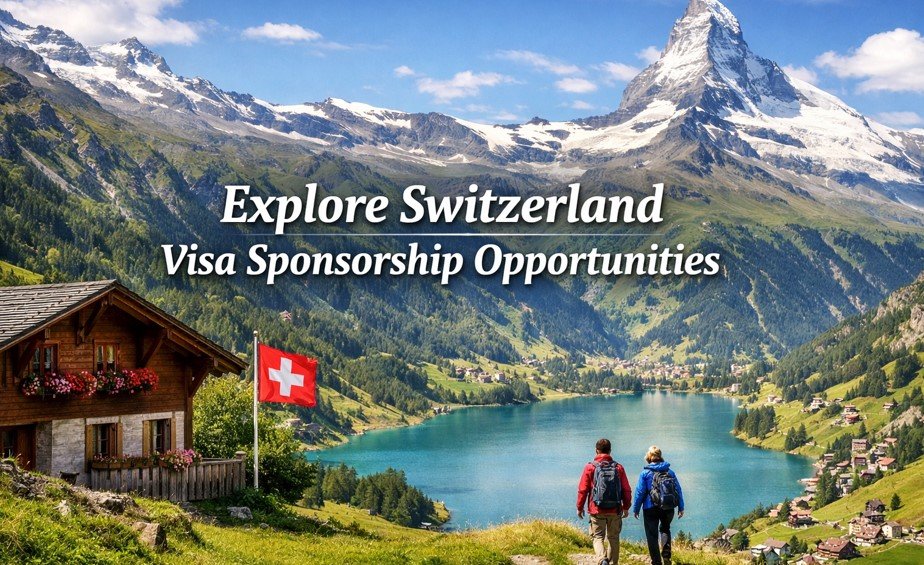
Explore Switzerland visa sponsorship opportunities is the first step toward securing a career in one of the world’s most stable and high-paying economies.
While the Swiss job market is known for its high standards and competitive nature, 2026 brings fresh possibilities for international professionals ready to bring their expertise to the Alpine nation.
Explore Switzerland visa sponsorship opportunities by understanding that the Swiss government has maintained a steady quota of approximately 8,500 work permits for non-EU/EFTA nationals this year.
This commitment ensures that Swiss companies can continue to recruit the global talent they need to fuel innovation in sectors ranging from biotechnology to advanced robotics.
Why Switzerland is the Premier Destination for Global Talent
Switzerland has built a reputation that transcends the simple imagery of luxury watches and pristine chocolate. In 2026, it stands as a global powerhouse of economic resilience and human development.
For professionals seeking more than just a paycheck, Switzerland offers a unique “ecosystem of success” that balances high-intensity innovation with an uncompromising focus on well-being.
Below is an expanded exploration of why Switzerland remains the premier destination for global talent.
Economic Stability and Global Financial Leadership
In a world frequently marked by geopolitical and economic volatility, Switzerland remains a “safe haven” of unparalleled stability. Its economy is built on a foundation of long-term fiscal discipline, a strong Swiss Franc (CHF), and one of the lowest inflation rates in the developed world.
For global talent, this translates to predictable purchasing power; the money you earn in 2026 is likely to maintain its value for years to come.
This stability attracts over 99% of Switzerland’s corporate landscape in the form of agile Small and Medium Enterprises (SMEs), alongside global financial titans like UBS and Zurich Insurance.
Working here means being part of a system where market crashes in other regions are often buffered by the country’s diverse and resilient export-led economy.
Unmatched Earning Potential and Favorable Taxation
Switzerland consistently offers the highest median salaries globally, with the average monthly gross wage in 2026 hovering around CHF 7,024. While the cost of living is high, the “net residue”, the money left over after all expenses, is often significantly higher than in the United States or the United Kingdom.
Furthermore, the Swiss tax system is remarkably favorable compared to its European neighbors. Taxes are levied at the federal, cantonal, and municipal levels, but the overall burden is relatively low, typically ranging from 20% to 25% for middle-income earners.
This unique combination of high gross pay and moderate taxation allows international professionals to build wealth, invest, and achieve financial independence at an accelerated rate.
A Global Hub for Innovation and Research
For 15 consecutive years, Switzerland has topped the Global Innovation Index, and 2026 is no exception. This isn’t just a title; it is a lived reality fueled by massive investments in Research and Development (R&D), which account for nearly 3% of the national GDP.
The country is home to the world’s most prestigious technical universities, such as ETH Zurich and EPFL Lausanne, which act as incubators for “Deep Tech” and biotechnology. Professionals in STEM fields find themselves at the epicenter of breakthroughs in medical robotics, AI-driven finance, and green energy.
The density of patents per capita in Switzerland is among the highest in the world, ensuring that if you are a creator or a scientist, you are working among the finest minds on the planet.
The “Three-Pillar” Social Security and Pension System
One of the most compelling reasons for talent to relocate to Switzerland is the long-term security provided by its sophisticated social insurance architecture. The “Three-Pillar” system is designed to ensure financial dignity from your first day of work through to retirement:
- First Pillar (OASI/AHV): State-run insurance intended to cover basic existential needs.
- Second Pillar (BVG): Mandatory occupational pension funds that ensure you maintain your accustomed standard of living.
- Third Pillar (3a/3b): Optional, tax-advantaged private savings that offer flexibility.
As of 2026, new reforms have strengthened these pillars, including the introduction of a 13th AHV pension payment and the ability to make retroactive “catch-up” payments into your Third Pillar for up to ten years.
This level of foresight in social planning gives expats a sense of security that is rare in more volatile labor markets.
Efficient Work Culture and Superior Work-Life Balance
The Swiss work ethic is defined by “precision over presence.” While the standard work week is approximately 40 to 42 hours, the culture emphasizes high productivity during those hours so that evenings and weekends remain sacred.
In 2026, Switzerland has seamlessly integrated hybrid work models, with many companies offering “telework” flexibility as a standard benefit. Burnout is actively discouraged by a legal framework that mandates 4 to 5 weeks of vacation per year.
This efficiency allows professionals to enjoy the country’s legendary “outdoor playground”, where one can leave a high-tech office in a city and be on a ski slope or a hiking trail within 45 minutes.
World-Class Infrastructure and Quality of Life
Living in Switzerland means experiencing a country that functions like a well-oiled machine. Whether it is the SBB railway system, which is famous for its to-the-second punctuality, or the universal healthcare system that provides immediate access to state-of-the-art medical facilities, the infrastructure is designed to reduce daily friction.
Safety is another pillar of the Swiss experience; crime rates are exceptionally low, and children often walk to school unaccompanied, reflecting a level of social trust that is a luxury in many other global hubs.
For the international professional, this means a life with less stress, cleaner air, and the peace of mind that comes from living in the world’s most stable democracy.
Understanding the Swiss Work Permit System (2026)
In 2026, the Swiss immigration landscape remains a masterclass in controlled precision. While many countries have moved toward more open “points-based” systems, Switzerland has doubled down on its quota-driven “Dual System.”
This ensures the economy gets exactly the specialists it needs without overwhelming local infrastructure.
For any international professional, mastering the nuances of this system is the difference between a rejected application and a successful relocation. Here is a deep dive into the mechanics of the Swiss work permit system in 2026.
The Quota Framework: A Strategic Ceiling for 2026
The Swiss Federal Council has officially confirmed that for the 2026 calendar year, the total number of work permits for non-EU/EFTA nationals (known as “Third-Country Nationals”) will remain stable at 8,500 units.
This is split into 4,500 B Permits (long-term residence) and 4,000 L Permits (short-term assignments). These quotas are not a “lottery” but a hard limit on how many international hires the Swiss economy can absorb.
Interestingly, data from early 2026 shows that these quotas are rarely fully exhausted; this is because the barrier to entry, the “High Qualification” requirement, is so stringent that only the most elite global talent successfully makes it through the vetting process.
The L Permit: Flexibility for Short-Term Specialists
The L Permit is designed for professionals whose presence in Switzerland is project-based or limited to a specific timeframe of up to 12 months. In 2026, this permit is frequently utilized by IT consultants, specialized engineers for infrastructure projects, and researchers.
While it is a “short-term” permit, it is often renewable for a second year if the project demands it. The primary advantage of the L Permit is that the processing time is generally faster than the long-term B permit, making it the “go-to” option for companies needing urgent expertise.
However, it is strictly tied to the sponsoring employer and the specific job description approved during the application.
The B Permit: The Gateway to Long-Term Swiss Life
For those seeking a permanent move, the B Permit is the gold standard. It is typically granted for an initial period of one year (for non-EU nationals) and is renewable annually as long as the employment relationship continues.
As of a landmark Swiss Supreme Court ruling in early 2026, B Permit holders now enjoy significantly more professional mobility.
Previously, third-country nationals were “locked” to their original sponsor; however, the new guidance allows B permit holders to change employers within Switzerland without a full re-application, provided they remain in a similar highly-skilled field. This change has made Switzerland a far more attractive destination for career-focused expats.
The “Stellenmeldepflicht” and Labor Market Testing
A critical hurdle in 2026 is the Stellenmeldepflicht, or the job notification requirement. Before a company can sponsor your visa, they must prove they searched for a candidate in Switzerland or the EU/EFTA region first.
In 2026, this requirement has been expanded to cover approximately 10.8% of the workforce, including roles in sales, marketing, and event planning. Employers must register the vacancy with the Regional Employment Centers (RAV) and wait five working days before interviewing international candidates.
For you as an applicant, this means your profile must be so specialized that a local recruiter can easily justify why no local candidate could match your specific “unique selling points.”
The “Shortage Exception” for STEM and Healthcare
Recognizing the dire need for specific talents, Swiss authorities in 2026 have streamlined the labor market test for shortage occupations. If you are a specialized nurse, a cybersecurity architect, or an AI researcher, the “burden of proof” for your employer is significantly reduced.
In these sectors, the authorities often waive the requirement for extensive proof of local recruitment efforts, acknowledging that the demand for these skills far outstrips the local supply.
This “fast-track” effectively creates a hidden “Shortage Visa” within the existing permit framework, providing a smoother path for professionals in technical and medical fields.
The Role of Cantonal Autonomy in Permit Issuance
Switzerland’s federalist structure means that while the Federal Council sets the quotas, the 26 Cantons (states) actually manage the distribution. Each canton has its own “labor market authority” that reviews applications based on local economic needs.
For example, a permit for a Fintech developer might be approved more readily in Zurich, while a Life Sciences permit might find a smoother path in Basel.
Understanding which canton your prospective employer is based in is vital, as cantonal authorities have considerable discretion over how they interpret “economic interest” and “integration potential.”
Key Requirements for the Switzerland Visa Sponsorship Opportunities
To successfully explore Switzerland visa sponsorship opportunities, one must look beyond a simple job offer and understand the rigorous technical and legal benchmarks set by the Swiss State Secretariat for Migration (SEM).
In 2026, the requirements have become even more focused on “economic necessity” and “high-level integration potential.”
Meeting these criteria is the only way to ensure that your application moves from a recruiter’s desk to the Cantonal Migration Office for final approval. Below is a comprehensive expansion on the key requirements for securing a sponsored position in Switzerland.
1. Proof of “Highest Professional Qualification”
The Swiss government does not grant work permits for unskilled or semi-skilled labor from outside the EU/EFTA. To explore Switzerland visa sponsorship opportunities, you must demonstrate that you are a “highly qualified” specialist.
In 2026, this typically means holding a Master’s degree or a PhD from a recognized international university, combined with several years of professional experience in your specific field.
For technical roles, such as software architecture or specialized engineering, a Bachelor’s degree may suffice if it is paired with globally recognized certifications (like AWS Professional, CISSP, or advanced LEED credentials) that prove you possess skills currently in short supply within the Swiss domestic market.
2. The “Priority” Rule (Labor Market Testing)
A fundamental requirement for any sponsorship is the legal confirmation that no “priority” candidate was available for the role. Under Swiss law, employers must first attempt to hire from the pool of Swiss citizens, residents, and EU/EFTA nationals.
For your visa to be approved, your employer must submit a detailed report to the authorities showing exactly where they advertised (usually for at least 30 days), how many local candidates they interviewed, and the specific, objective reasons why those candidates were not suitable compared to you.
This is why targeting “shortage occupations”, such as AI development, specialized nursing, or renewable energy engineering, is the most strategic way to explore Switzerland visa sponsorship opportunities.
3. Salary Parity and “Market Standard” Compensation
Switzerland is fiercely protective of its high wage standards and seeks to prevent “social dumping” (the hiring of foreigners at lower rates to save money). A mandatory requirement for visa sponsorship is that your offered salary must match or exceed the local and industry-standard “going rate.”
In 2026, the authorities use an online calculator called Salarium to verify this. If a software engineer in Zurich typically earns CHF 125,000, but your sponsor offers you CHF 90,000, the migration office will reject the permit to protect the local economy.
For the applicant, this is actually a benefit, as it guarantees you will be paid a fair, high-tier wage upon arrival.
4. Integration Capability and Language Proficiency
While your professional skills get you the job, your “integration potential” gets you the permit. In 2026, Swiss authorities place a heavy emphasis on how well a newcomer will adapt to Swiss society. This includes a clean criminal record and a “professional reputation” that suggests long-term stability.
Furthermore, while many multinational offices operate in English, the requirement to show basic proficiency in a national language (German, French, or Italian) has become more strictly enforced for B-permit renewals and certain initial applications.
Having a certificate showing even an A1 level of a national language can be the “tie-breaker” that convinces a canton to allocate one of its limited quotas to you.
5. Detailed Job Description and “Economic Interest”
The role itself must be deemed of “significant economic interest” to the Canton. When an employer applies for your sponsorship, they must provide a robust job description that outlines how your specific role contributes to the innovation or financial health of the region.
For example, if a company in Basel is hiring you to lead a clinical trial for a new oncology drug, they will highlight how your presence supports the local “Life Sciences Cluster.”
To explore Switzerland visa sponsorship opportunities effectively, you should work closely with your prospective employer to ensure the job description highlights the high-value, specialized nature of the work you will be performing.
6. Mandatory Health Insurance and Financial Self-Sufficiency
Finally, to secure your visa, you must prove that you will not become a burden on the Swiss social system. This is partially covered by your high salary, but it also involves a commitment to enroll in the Swiss private health insurance system (KVG/LAMal) within 90 days of arrival.
You must also demonstrate that you have the financial means to support any dependents (spouse or children) you intend to bring with you under “Family Reunification” rules.
In 2026, authorities often require a specific “financial plan” or proof of housing to ensure that the family will be comfortably accommodated without state assistance.
Strategic Guide on How to Secure Switzerland Visa Sponsorship Opportunities
Securing a job in Switzerland is not about volume; it is about precision and strategy. In 2026, the Swiss labor market is more data-driven than ever, and recruiters use sophisticated software to filter out any application that doesn’t meet the “Swiss Standard.”
To win a sponsored role, you must transform your approach from a generic job seeker to a “critical solution” for a Swiss company.
Below is an expanded strategic guide to navigating this journey successfully.
Engineering the Swiss-Style CV (Dossier)
A Swiss “dossier” is far more comprehensive than a standard American resume. In 2026, it is standard practice to include a professional headshot in the top corner, this should be a high-quality, formal photo, not a casual selfie.
Beyond aesthetics, your CV must be factual and “telegraphic.” Avoid flowery language like “passionate team player” and instead focus on quantifiable results, such as “Managed a budget of CHF 2M with a 15% cost reduction over 18 months.”
More importantly, you should explicitly state your work permit status (e.g., “Non-EU national requiring sponsorship”) and your date of birth, as Swiss recruiters value this level of transparency from the outset.
Targeted Networking through “Swiss Career Hubs”
In Switzerland, up to 70% of high-level roles are filled through the “hidden job market” or internal referrals. To tap into this, your 2026 strategy must involve active participation in Swiss-specific career events.
Major universities like ETH Zurich and the University of St. Gallen (HSG) host massive career fairs such as Polymesse and HSG Talents, which are often open to external professionals or alumni.
Additionally, engaging with Swiss industry associations on LinkedIn, such as SwissICT or Swiss Biotech, can provide direct lines to hiring managers. Don’t just apply online; reach out to “Talent Acquisition Specialists” at your target companies to ask insightful questions about their 2026 innovation roadmaps.
The “Language of Trust”: CEFR Levels and Local Nuance
While English is the lingua franca of multinational giants like Google or Novartis, demonstrating a commitment to a local language (German, French, or Italian) is a significant competitive advantage.
In 2026, many B Permit applications require proof of language proficiency at an A1 or A2 level under the Common European Framework of Reference (CEFR). Even if the job is in English, including your “Goethe-Zertifikat” or “DELF” level on your CV signals “integration potential.”
This tells the recruiter and the migration authorities that you are a long-term investment who will fit into the local social and professional fabric.
Overcoming the Labor Market Test with “Unique Selling Points”
To sponsor you, a Swiss employer must prove to the Cantonal Migration Office that no Swiss or EU/EFTA candidate could do the job. Your goal is to make it impossible for them to find a “local” match.
You do this by highlighting niche certifications or cross-functional expertise that are rare in Europe. For example, if you are a Software Engineer with specific experience in “US-Swiss Data Privacy Compliance” or a doctor specialized in a rare robotic surgery technique, you become a “unique asset.”
In 2026, roles involving AI Ethics, ESG Reporting, and Quantum Computing are currently seeing the highest rates of successful labor market test waivers.
Navigating the Digital Application Portals (e-Permits)
By 2026, most Swiss cantons, including Zurich and Geneva, have fully digitized their permit application systems. This means your documentation must be “digital-ready.” Ensure your university degrees are accompanied by a Diploma Supplement or an official equivalency statement.
If you are applying for a regulated profession (like healthcare or law), you must have your credentials recognized by the State Secretariat for Education, Research and Innovation (SERI) before the employer even starts the visa process.
Being “pre-verified” reduces the administrative burden on the employer and makes you a much more attractive candidate for sponsorship.
Leveraging Specialized Recruitment Agencies
In 2026, many Swiss companies outsource their “Global Talent Search” to specialized agencies like Michael Page Switzerland, Robert Walters, or Adecco.
These agencies often have direct quotas or “fast-track” relationships with cantonal authorities. Instead of only applying to company websites, register with these firms and clearly state your need for visa sponsorship.
They act as your “broker”; if they believe in your profile, they will do the heavy lifting of convincing the employer that you are worth the sponsorship effort.
Conclusion
Explore Switzerland visa sponsorship opportunities with a mindset of excellence. The Swiss market doesn’t just want “workers”; it wants “specialists.” By aligning your skills with the country’s high-tech and healthcare needs, you can turn the dream of a Swiss lifestyle into a reality.
The door to Switzerland isn’t closed; it’s just heavily guarded by a preference for high quality. If you can prove you are the best person for the job, the visa is simply a formality in a very rewarding journey.